About this game
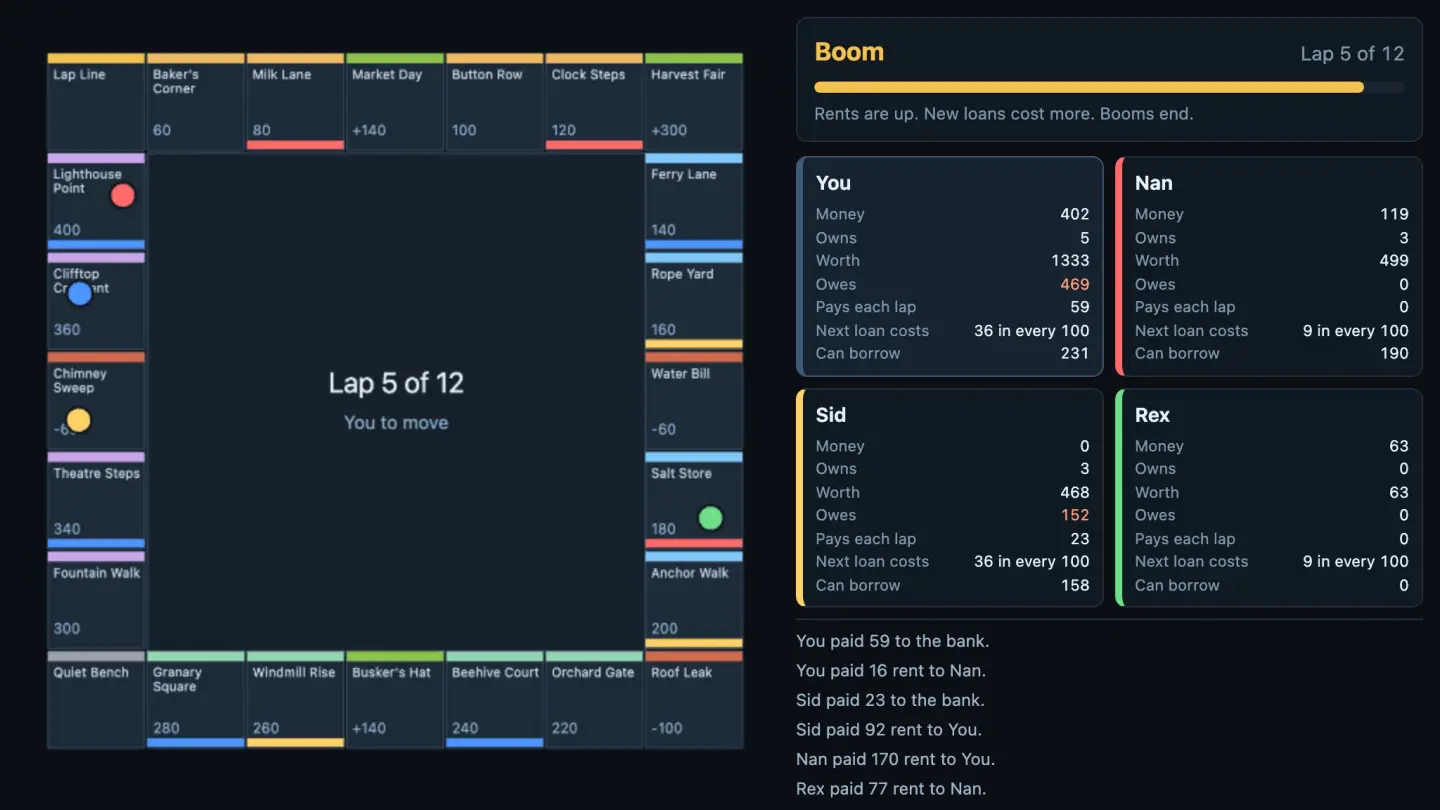
Lapline is a budgeting game played on a board. You walk a ring of streets with three other players. Land on a street and you can buy it. From then on, anybody who lands there pays you rent.
The catch is the bank. Rent only comes in when somebody happens to land on you — some laps you earn plenty, some laps nothing. But the bank's bill comes every single lap, the moment you cross the Lap Line, whether it was a good lap or not. Money that arrives sometimes, against a bill that arrives always: that gap is the whole game, and it is the same gap every real budget lives in.
Miss the bill and the bank does not send a letter. It takes one of your streets and sells it, cheap, to a rival. The board changes colour so everyone can see it happen.
How to play
- Watch your money, not the streets. You start with 500. The first street is always bought with cash, because the bank only lends against what you already own.
- Buy what you land on, if it pays. A street's rent is a quarter of its price, so dearer streets charge more — and cost more to reach.
- Borrow when the rent beats the cost. The bank lends up to half of what your streets are worth. Each loan you already have makes the next one cost more: the first is cheap, the second is the one to think hard about.
- Keep enough back for the bill. Your card shows what you pay each lap. Spending your last coin on a street means missing a bill you could have paid.
- Watch the meter. In a boom, rents climb and new loans cost more — together. Booms end in a crash, on a lap nobody knows in advance. After the crash comes a slump: rents fall, and new loans go cheap.
- Twelve laps, then it ends. Everyone runs the same twelve laps and pays exactly twelve bills. The richest player wins: money, plus streets, minus debts.
Controls
| Input | What it does |
|---|---|
| Click or tap | answer the buttons when a street is for sale |
| B · L · N | buy it · borrow and buy · no thanks |
| P | pay some of your debt back |
| Esc or the pause button | pause, and the way back to Playpit |
| Fullscreen | hides the browser so the game has the whole screen. Press it again to bring the browser back |
The three neighbours
You share the board with Nan, Sid and Rex, and the three of them are the lesson.
- Nan never borrows. She buys what her cash covers and nothing more. She almost never loses a street — and she almost never wins the board either.
- Sid borrows when it pays. He takes a loan when the street's rent will cover the interest, and pays debt down when he has spare money. Over many games, Sid wins more than anybody.
- Rex borrows for everything. He ends most games worth about the same as Nan — all of the risk, none of the reward — and he comes last far more often than either of you.
That spread is not a story we wrote. We played this exact board thousands of times to check it: careful borrowing beats never borrowing, and borrowing for everything mostly just buys you a worse bad day.
The boom, the crash, and the card
The meter above the seats is the market. It starts calm, climbs through a boom, and then — on a lap the dice chose before the game began — it crashes. Two laps of slump, a slow recovery, and the board plays out.
Here is the part worth knowing: a loan keeps the price it was written at. Money borrowed cheap in the slump stays cheap for the rest of the game. Money borrowed dear at the top of the boom stays dear all the way down — while the boom rents that justified it disappear. The players who get hurt in the crash are the ones who borrowed most at the top. The higher the meter, the closer the cliff.
When the twelfth lap ends you get your crash card: the lap the market turned, what you owed at that exact moment, and whether you held on or lost a street to it. The card carries a link that rebuilds the same board — same streets, same dice, same crash lap — so the person you send it to plays your game and finds out whether they would have survived it.
Tips for your first board
- Treat the bill as money you don't have. Your card shows what you pay each lap. Keep at least that much in hand, always, and a bad lap is a bad lap instead of a lost street.
- The first loan is usually right. The second usually isn't. Every open loan makes the next one cost more, and on this board the second one costs more than a street earns. Read the two numbers the game shows you before you press the button.
- Pay debt down while the meter is high. The "Pay back" button clears your dearest loan first, which drops the price of your next one a whole step — and it means the crash finds you light.
- Borrow after the crash, not before it. Slump loans keep their slump price forever, and the rents come back. That is the whole timing bet, and it wins games.
- Don't buy your way to an empty pocket at the top of a boom. That street's boom rent is about to halve. Your bill isn't.
Good to know
- The money in Lapline is game money. There is nothing to buy with real money, nothing to unlock, no coins and no sign-up. No chat, and no way for players to contact each other.
- Nothing is sent anywhere. The game runs in this tab, and a shared link carries only the board number and the sharer's result.
- It plays on a phone, a tablet or a computer. On a small screen the board and the buttons stack, and the game waits for you whenever there is a decision.
- A whole board takes a few minutes. The game pauses whenever a street is for sale for you, for as long as you need.
If you want the ideas behind the game in words first, start with how a budgeting game teaches what a worksheet cannot, then how the bank in a banking game really works — the ceiling, the rising rate, and why the second loan is the trap — and where Lapline fits among financial literacy games. For more games that teach something real, Swivelhead is crossing the road on foot and Wheelabout is the same roads from the driver's seat.