About this game
Chalkwick is pool, except the room will not stay a rectangle. That is the whole idea. Every other pool game you can play in a browser is the same green box with the balls moved around. Here the box itself is the puzzle.
You start on a normal table, because you have to learn where to aim before anything else is interesting. By the third back room there is a post standing in the middle of the felt and you have to go round it. After that the rooms stop being kind:
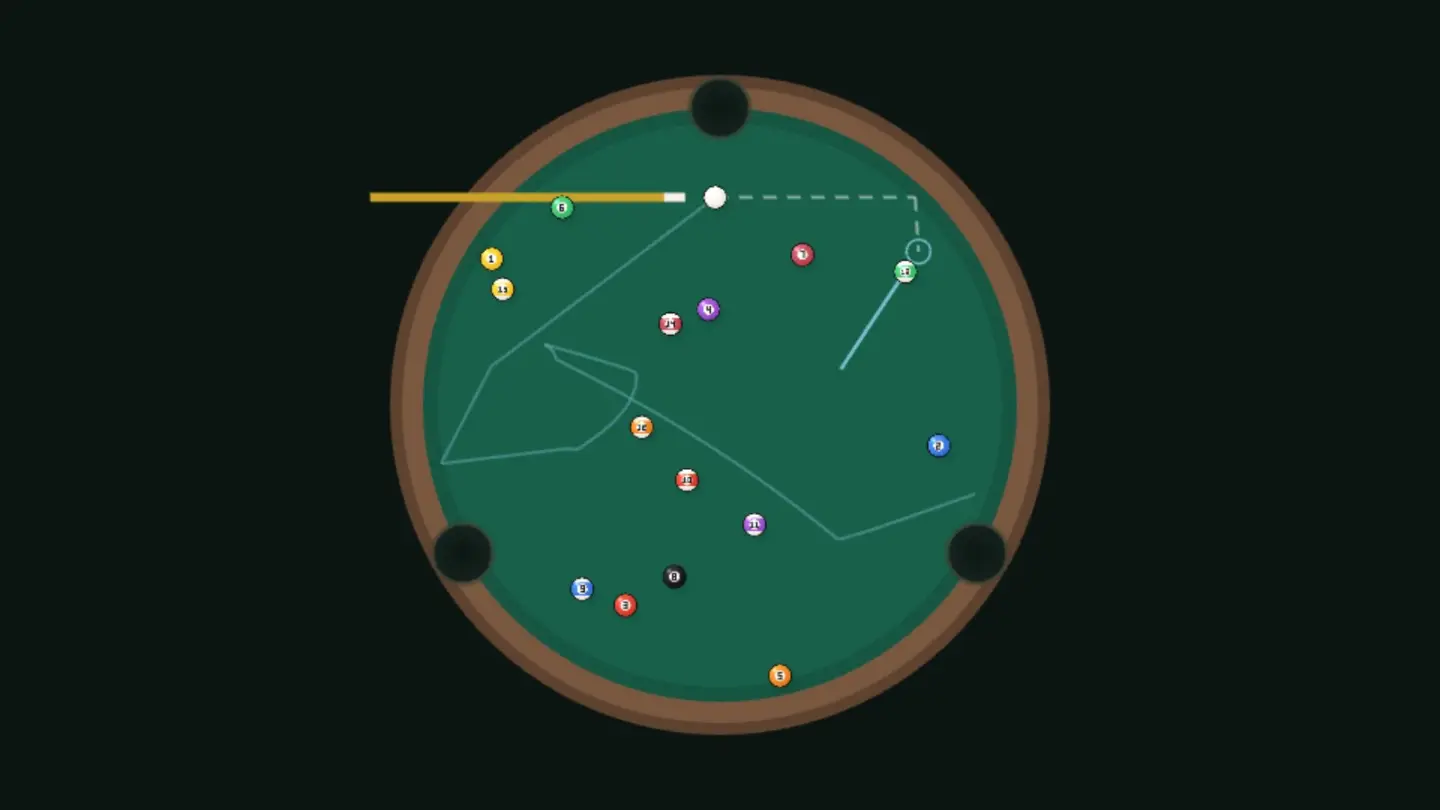
- The round room has a rail with no corners at all. On a normal table you learn that a ball comes off a cushion the way it went in. On a circle every bounce points back at the middle, so all of that has to be thrown away.
- The bent room is an L. There is a corner you cannot see round, and a ball sitting in the far arm has no straight line to it whatsoever. You have to go the long way.
- The lighthouse wires two of its pockets together. A ball that goes down one comes back out of the other, still travelling, still yours.
The balls behave properly
A ball in Chalkwick carries spin as well as speed, which sounds like a detail and is actually the whole feel of the game. Hit the white above the middle and it runs on after the contact. Hit it below and it comes back to you. Neither of those is a special case somebody programmed in — they fall out of the way the ball is modelled, the same way they fall out of a real table.
Side spin does what it should too. Put some on and the white comes off a cushion at a different angle than it went in, shallower one way and wider the other. Most browser pool games just mirror the angle, which is why they feel wrong to anyone who has held a cue.
How to play
One gesture does everything. Point where you want the white to go — the further from the ball you point, the finer the aim gets, which is what makes this work on a phone. Then drag back to draw the cue, and let go to shoot. The line locks the moment you press, so pulling the cue back can never wobble your aim.
The dashed line shows where the white is heading and where it will bounce. The small circle is the ghost ball — where the white will be at the moment it touches. Line that circle up against the ball you want, on the opposite side from the pocket, and the pot goes in. That one idea is most of pool.
Bottom-left there's a little white ball with a red dot on it. That's the spin dial. Drag the dot up and the white runs on after the contact; drag it down and the white comes back to you; drag it left or right and the white comes off the cushions at a different angle. Double-tap it to put the dot back in the middle.
Controls
| Input | What it does |
|---|---|
| Point | set the line — the further out you point, the finer the aim |
| Drag back | draw the cue; let go to shoot |
| Spin dial | drag the dot for follow, draw, or side |
| L | the eight back rooms |
| S | set the table — room, rules, opponent |
| A | how far ahead the guide looks |
| R | rack them up again |
| T | show the white's trail |
| M | sound on/off |
| Fullscreen | hides the browser so the game has the whole screen. Press it again to bring the browser back |
Tips
- Hit it softer. Nearly everyone hits too hard. A ball arriving fast rattles out of the jaws, and it drags the white somewhere you did not want it.
- Watch where the white stops, not just whether the ball went in. Half of pool is leaving yourself something to do next.
- Turn the guide down when it stops teaching you. Three cushions is a lot of help. Drop to one, then to none, and you'll find you already know where the ball goes.
- In the round room, forget everything about corners. The rail curves, so a bounce always heads back toward the middle. Aim to use that rather than fight it.
- In the bent room, take the long way on purpose. If there is no line, there is no line — stop looking for one and start looking for a cushion.
You do not have to do the story
The table is already racked when this page finishes loading, and the first click shoots. Nobody arriving here should have to sit through anything before hitting a ball.
Everything is unlocked from the start. Pick any of the four rooms. Play 8-ball, play 9-ball, or turn the rules off entirely and just hit balls with no turns and no fouls — which is the best way to find out what the spin dial does. Play against nobody, or pick an opponent.
The opponent is honest about how good it is
There are three of them, and they do not cheat. None of them decides in advance whether a shot goes in. Each one looks at the table, works out a shot that genuinely works, and then its hand shakes a little — more on a long thin cut, less on an easy one, exactly like a person.
Because of that, their difficulty is a measured number rather than a claim. Across ninety tables, steady takes 32% of the chances it gets, sharp takes 50%, and deadly takes 69%. None of them plays worse on purpose when it is winning.
About the target shot counts
Every one of the forty tables has a number of shots to beat, and the game worked that number out by playing the table itself before you ever saw it. So it is a real line that really clears, not somebody's guess.
One honest caveat, because it matters: that number is the best line the game found, not a proof that no shorter one exists. Pool has infinitely many possible shots, so unlike a sliding puzzle there is no way to prove a minimum. If you beat it, you beat it fairly — and that is the point.
Good to know
- It's free, there's nothing to download, and there's no account to make.
- Your stars and how far you've got are saved in this browser. Clear your browsing data and they go with it, and they don't follow you to another device.
- It works on a phone. The aiming was built for a thumb first — pointing further from the ball makes the aim finer — so a small screen isn't a compromise here.
- There's no multiplayer and no chat. If you want to challenge someone, finish a table and send them the link: it rebuilds the identical table for them to try.
- Every ball, cushion and pocket you can see is drawn by the game from scratch when the page loads. Nothing is downloaded, which is why it starts as fast as it does.